By Ken Farren
IALEFI Control #20-05
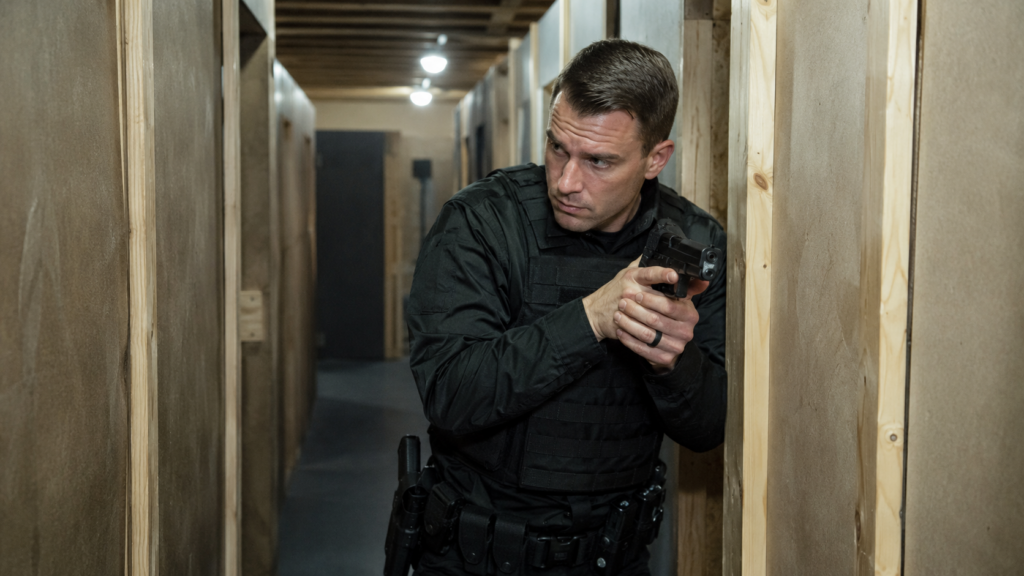
National statistics advise year after year that most police officers are killed in the 3–7-foot range. That’s confined space and we had better train our officers how to survive in that space or they will die in it. The definition of the verb “confined” is to keep within bounds; to restrict movement. It is the second definition that concerns us the shootist in a combat situation because often that where we find ourselves when things can get as bad as they can get, restricted in movement. Constricted space or linear space engagements are always “up close and personal,” so that the tactics of time, distance and cover that are applicable under other circumstances do not apply. In a close encounter of the first kind, you need to be capable of properly handling, maneuvering and employing your weapon in any situation you may find yourself thrust in to. In constricted space combat the urge to fight or flight will be instantaneous. Learned constricted space weapon(s) movements and shooting techniques are essential to your professional development and yourself preservation.
Training
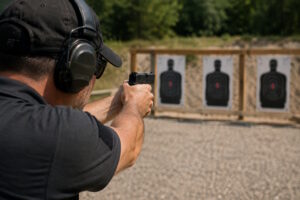
Most current department generated training {because of safety issues, time restraints or the lack of enthusiasm by the range master} requires that training be conducted under the following conditions.
- A. Sterile conditions {range}
- Adequate distance from target
- Stable shooting platform
- Department trained stance and grip
- Adequate sight alignment
Real world conditions how ever involve inadequate time and insufficient distance. {Distance almost always equals reaction}. Often in a shootout there are obstacles such as chair, seats, poles, doors, and things that impair our ability to fight the good fight.
In the real world in the mist of a raging gun battle we do not always have that solid platform we had at the range. We find ourselves among the clutter of a dope house full of dirty clothes, children, toys, bags and things under foot or in a ditch half full of stagnate water, brush, bugs and things. On the range we usually shoot in the daytime, or we simulate with beacons and flashlights, but in Bubba’s world when he’s fixen’ to drop the hammer on you there may be some light, there may be low light, or there may be no light. On the range we know everyone is going to be safe. You know your guys are going to stay left and right of you and never cross in front of your muzzle, but in the real world, when executing that high-risk warrant or hostage rescue you are going to have deal with all types of people being in your line of fire. Good guys, bad guys and yes even your guys. If we do get off a shot, we have been trained by our range master, each other, and in the movies to believe that our shot is going to have an instant effect. Then we freeze when the suspect fails to react the way we think he will when shot. In the real world our perception may not be reality. On the range we line up and fire at flat nonresponsive black and white faceless targets when in reality our killer may be a 14-year-old child trying to get into that gang and killing you with a 12 gauge shotgun from 5 feet away is how he is going to do it.
Situations
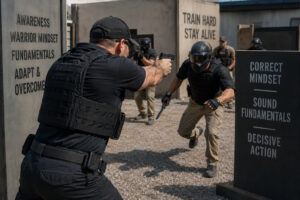
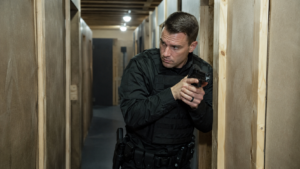
Calls that we make every day on the street require us to be able to deploy our firearm. We need to train our students to be able to react in confined space situations involving the seated position of a patrol vehicle among all the computers, shotgun racks and steering wheels. Our officers deserve to know that clearing a motel or hotel room is different from clearing a chalked out static room draw on the ground at your range. Our officers need to know there are tactics that will save their lives in hallways, gangways, and alleyways that are no different from the ones used by tact teams for house trailers, aircraft or watercraft. Officers should be able to survive a shoot out in garage full of used cars or a warehouse full of new washers and dryers not just win the department sponsored bowling pin match.
Limited penetration is an art that should not only apply in the bedroom but should be practiced in closets, bathrooms and almost any doorway in a combat situation.
Weapon Selection
Confined space engagement most often involves whatever weapon is at hand. Consideration should be given to the flexibility of that weapon before it is carried. Questions must be answered such as is it capable of one hand operation? Is it capable of deployment close to body to prevent disclosing the officer’s position? Is it efficient in caliber? It may be necessary for the officer to move objects or persons while still prepared to deliver accurate, short distance fire. The weapon carried must be easily adapted to changing circumstances. The firearm should be accurate at short, relative distances; target presented target engaged. The firearm should be capable of neutralizing the threat, be easily accessible and deployed quickly.
Controllability
In confine space engagement controllability is paramount as one-handed operation is very likely. In any environment it may be necessary to draw the weapon close and tight to the body. The Shooter may need to move around obstacles, so the weapon needs to be easily adapted to a weapons retention position. Lastly, the shooter needs the ability to immediately secure that weapon if the situation dictates because of an arrest, physical confrontation, officer injury or negotiating obstacles.
Weapons skills
Confederate civil war hero General Bedford Forrest said” in any fight it’s the first blow that counts and if you keep it up hot enough, you can whip ‘em as fast as they come up”. Unfortunately, we don’t often get the first blow and even our reaction shot is hampered by the environment in which we find ourselves. Weapon position in a confined space engagement is dictated by the space itself and requires versatility. Ability to acquire the sights may not be available and will most often cause the shooter to use an unorthodox method of shooting in addition to all the other factors already mention. The officer who wants to survive needs training in flash sight sighting. That is the ability to see just the front sight and press the trigger when he indexes the desired target. Because time is going to be at a premium in the real world and he will not have time to get that prefect sight picture you drew diagrams of on the chalk board at the range.
Instinctive or point shooting as Col. Applegate called it should be second nature to the shooter and capable of being fired from chin level to the waist.
Two handed high sternum hold may be required when shooting from a cramped position, yet the shot must be quick and over the top of an obstacle. The “Greg” or handshake position can be taught and mastered in one day and 500 rds at the range but has already saved many lives on the streets. The weapon retention position or anchor point is one in which the weapon is draw quickly and indexed along the rib cage. The gun is anchored so it is never in reach of the suspect yet can be fired accurately from close distance.
All these methods should be employed only long enough to inflict maximum damage. The shootist should then create distance, go to cover and acquire a good two handed ,eye indexed, shooting position that any range master would be proud of and engage again if necessary.
Additional Factors
Constricted space shooting is unfamiliar unless practiced at the range both in live fire and red gun exercises. The support hand must be protected both during training and during engagement. The unstable shooting platform should be practiced but must be done safely again both with red gun and live fire. The student should be made well aware both through lecture and demonstration that in confined space engagement there will be amplified gun shot noise, muzzle flash, smoke and gas not normally experienced by the shooter whose weapon is extended at arms length.
Considerations
After learning the different methods of confined space engagement, the trainer should ask both himself and his students the following questions then develop his training course around those answers.
- Which constricted space shooting style works best?
- Which is quickest?
- Which is more accurate?
- Which allows for best multiple target engagement?
- Which accommodates my department weapons system best??
My advice to you and your officers is to train hard, as if your life depends on it, and never assume it’s going to happen to the other guy. Depend on your training and your instincts to survive and strive to do the right thing always.
About the Author: Lt. Ken Farren (ret.) with 26 years in Law Enforcement has been the recipient of 3 life saving awards, and over 25 departmental commendations. Ken is a survivor of several police shootings. He owns “SHOOTERS EDGE,” a firearms training center in Amarillo, Texas. As a former swat commander, he has trained law officers all over the U.S. and abroad. Ken is a winner of the Texas Peace Officer award and has been an IALEFI member in good standing since 1985. He is an FBI, NRA and TEXAS DPS certified firearms instructor.