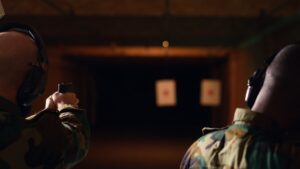


Effective employment of the patrol rifle by law enforcement officers is reliant upon a successful training program, whether it is taught in house, through a state training academy, or through some other vetted source. Specifically, one aspect of patrol rifle training that is extremely important to officer survival is the transition to handgun in the face of malfunction or an empty magazine. This skill, in my opinion, should be developed and drilled early in a training program and reinforced through subsequent courses of fire, to include annual qualifications.
Placement Within Lesson Plan And Demonstration
Keeping the obvious notion that no two training courses are exactly alike, we will probably agree that most patrol rifle courses, at least those with merit, will teach similar concepts. Nomenclature, zeroing the sight systems, use of cover, and malfunction drills would be mainstays in their lesson plans, for example. Likewise, the transition to handgun, even though it is a course centered around using long guns, needs to be included with these other fundamental patrol rifle skills and, likewise, introduced and developed early in the training program.
In the current lesson plan used by my organization, transitioning to the handgun is emphasized and implemented on the second day of the forty hour course. It begins with a demonstration of the transition process at combat speed by an instructor and then followed by further demonstrations broken down to highlight each step. The cadre members then stress the life saving importance of this skill by doing a head to head demonstration. Both instructors have a three round magazine loaded into their weapon. When they both come up empty, while putting rounds on respective threats, one instructor reloads the patrol rifle while the other transitions to his handgun and continues to engage a threat. The speed at which the transitioning officer is able to get subsequent rounds on the threat is markedly faster than the reloading officer and tends to make a distinct impression on the student, thus effectively illustrating the life saving value of this skill. This can also be performed with dummy rounds to produce a failure to fire malfunction, but, will allow the student to draw from this demonstration the intended teaching point, as well.
The transition process is also placed in the lesson plan directly after the immediate action drills, taught to the students to correct malfunctions. This is done in order to drive home the concept that regardless of the stoppage, if the student experiences a dead trigger in the face of the threat, the proper reaction is to transition to the handgun. Subsequently, during the assessment phase of the transition process, the student still has the manipulation skills to put the rifle back in service rapidly.
Transition Process
The process of transitioning to the handgun from the rifle, as it’s coached by the training staff of my own organization, is simplistic and emphasizes a continued response to a continued threat. As the shooter puts rounds on a threat with the patrol rifle, he or she experiences a dead trigger. Upon perceiving this, the shooter’s fire control hand activates the safety and releases the grip as the support hand rotates the weapon so that the ejection port faces the ground. Simultaneously, as the support arm lowers the weapon to the support side of the shooter’s body, the strong hand goes to the side arm and draws it from the holster. As the rifle reaches its final rest on the support side of the shooter’s body, the support hand releases the hand guard and rises to meet the strong hand finishing the handgun presentation. The shooter then resumes putting rounds on the threat with the two hand combat grip. As stated before; a continued response to a continued threat. Following the transition, the stoppage is assessed while the student still has the handgun oriented towards the threat direction. The example described here is based on the patrol rifle having a tactical sling attached at a single point. Two point slings and other variations, such as having no sling, will cause simple adjustments in the manipulation of the weapon, however, the concept of uninterrupted response remains.
Dead Trigger
Tactical considerations notwithstanding, experiencing a dead trigger, or getting a “click” when expecting a “bang”, should be the source of the transition to handgun when faced with a threat. To embed this point in your patrol rifle class, the dead trigger should come when they least expect it. Simply having them load a prescribed number of rounds in a magazine, step onto the firing line and perform the transition will allow them to learn the mechanics of the transition process, however, true understanding of when to use it may possibly elude them. In my experience, when the stoppage comes unexpectedly, later in the course or during subsequent training, they will be wondering why the weapon malfunctioned when they are supposed to be concerned with stopping a threat.
To combat this result, the drills used to train the transition should be with magazines that contain a number of rounds unknown to the shooter. This results in a truer implementation of the transition process when the stoppage occurs and will demonstrate if the student grasps the core concept of the transition, a continued response to a continued threat, or is just going through the physical mechanics of the drill. Likewise, do not allow the student to reload the rifle or fix the malfunction until they have assessed the stoppage while still transitioned to the handgun and oriented toward the threat direction. This last part of the process ensures the student stays in the survival mindset throughout the entire course of fire.
Conclusion
Whether you condition your students’ responses through having different firing orders load each other’s magazines with a number of rounds not known to the shooter or through the use of dummy rounds, the concept of the transition must be taught and drilled early in the lesson plan. This will ensure that it becomes a fundamental part of their patrol rifle manipulation. The value added benefit will become apparent to the student through subsequent drills on the range and translate to more confident use of the patrol rifle in situations that face these officers on the street.

In the above photo array, the transition to handgun process for a single point sling is broken into steps. Notice, after the cover and scan for additional threats, the rifle stoppage is assessed with the handgun in the direction of last threat. Photos are courtesy of Aaron Adams.
About the Author: Eric Crayner is a police officer in Kentucky with 15 years of experience. His assignments have included patrol, investigations, and SWAT. He currently serves in the Training Section for his department as a firearms instructor.